100 MW BESS site layout
What a 100 MW battery storage site looks like: real layouts generated by the SiteLayout.ai solver at 2-hour and 4-hour duration, with the land and equipment figures they imply.
100 MW / 400 MWh — 4-hour duration
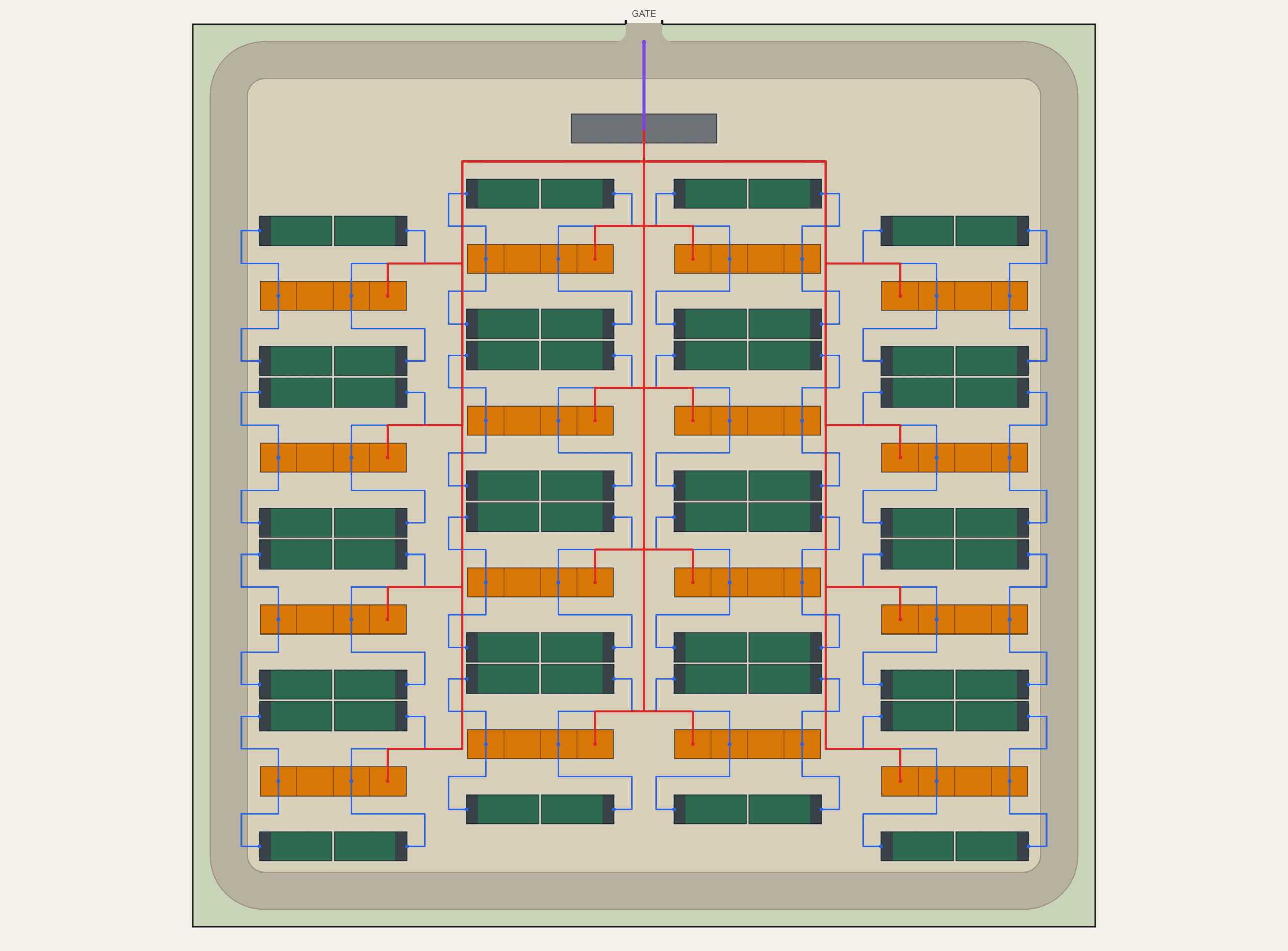
Actual solver output: 75 × 75 m site, perimeter ring road, default spacing rules, cabling routed to the Point of Interconnection (POI).
100 MW / 200 MWh — 2-hour duration
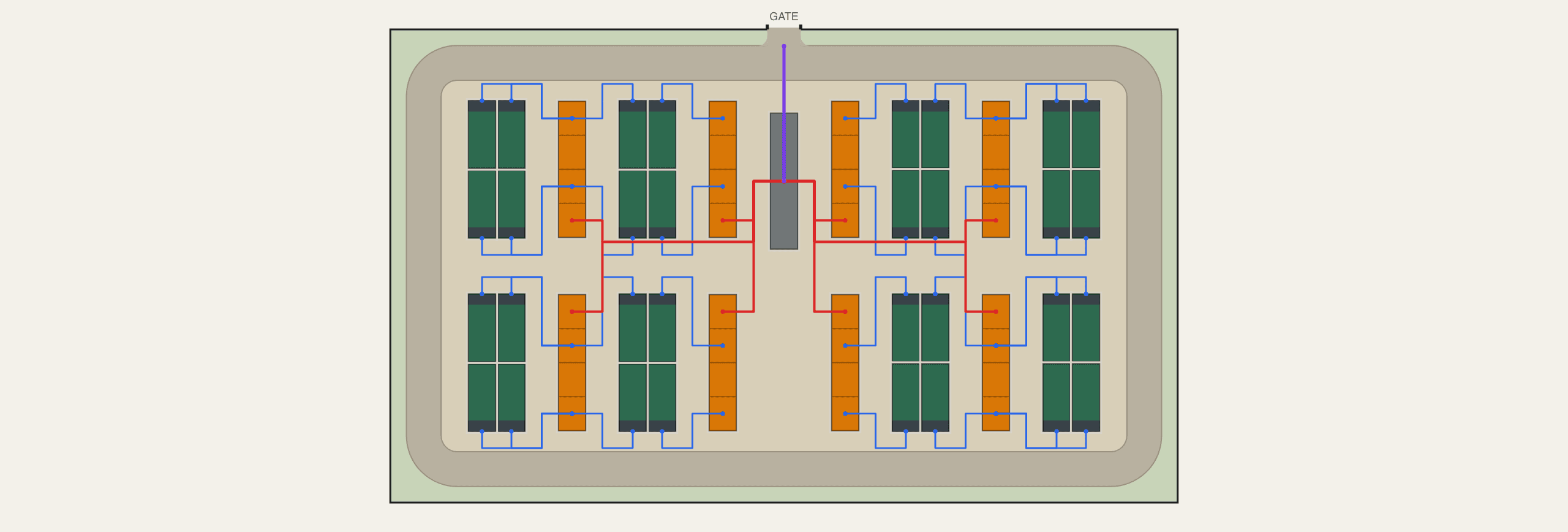
Actual solver output: 71 × 42 m site, perimeter ring road, default spacing rules, cabling routed to the Point of Interconnection (POI).
Frequently asked questions
How much land does a 100 MW BESS need?
At 4-hour duration (400 MWh), the fenced equipment area is 1.4 acres (0.57 ha); at 2-hour duration (200 MWh), 0.74 acres. Both figures come from the layouts on this page — real solves with 6.25 MWh DC blocks, a perimeter ring road, 5 m safety distance between DC clusters, and a 1.5 m boundary setback. Add land for the HV substation, laydown, and stormwater.
How many DC blocks does a 100 MW BESS use?
64 DC blocks (6.25 MWh, 20 ft) at 4-hour duration, 32 at 2-hour. The 4-hour build pairs them with 16 PCS & MV skids, the 2-hour build with 8 — one skid per DC cluster, following the solver's Auto pairing rule.
What E-house does a 100 MW site take?
40 ft (MV + control + aux · 50–100 MW). The format is set by site power: 20 ft up to 50 MW, 40 ft up to 100 MW, and a 15 × 4 m walk-in building above 100 MW.
Are these real layouts?
Yes. Every image on this page is unmodified output from the SiteLayout.ai solver on a site sized to the target capacity, with default spacing and road rules. The same solver runs in the layout tool on any boundary you draw.
Why does the 2-hour version need less land?
Land tracks energy, not power. A 2-hour system stores half the MWh of a 4-hour system at the same MW, so it uses roughly half the DC blocks and roughly half the area.
Related
These are reference sites. For the real 100 MW project, draw the boundary in the layout tool and the same solver packs the actual site.
Start a layout